
What Should an International Student Do in the First 24 Hours After Landing Abroad?
Afraid of the first 24 hours abroad? Read this.
Landing in a country is truly exciting. It can also feel confusing. Suddenly, travelling abroad requires knowing where to go and what to do next. When travelling abroad alone, it is completely normal to feel that way, as it brings responsibilities.
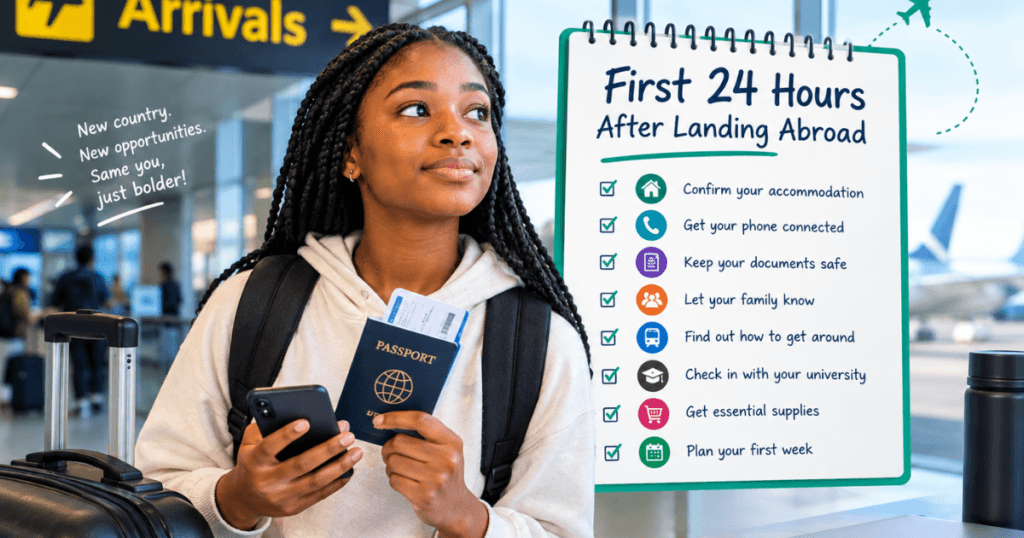
The first 24 hours abroad should mainly focus on finding a place, confirming accommodation, keeping documents safe and knowing what to do. Universities often suggest steps. These steps are arranging transport, attending orientation, getting a student ID and setting up essentials after you arrive.
Here is a checklist of what you should do as an international student experiencing your first 24 hours abroad:
Get Through the Airport Calmly and Keep Your Documents Close
After you get to the airport, don’t hurry just because you want to leave. Take your time. Look at the signs inside the airport for baggage collection and arrivals. Make sure you keep your passport, your visa, and all your immigration documents safe. Also have your university admission papers and your accommodation details ready in a place where you can find them quickly.
This is especially important because immigration officers may need to check your documents when you arrive. Immigration officers may have different requirements depending on the country and your immigration status.
For example, students travelling to the United Kingdom might have to present their travel and immigration documents upon arrival at the border. The UK government tells travellers to ensure their required documents are ready for border checks.
In Canada, international students must bring documents such as a passport, a letter of introduction for the study permit, a valid acceptance letter from their school and any other documents. Canadian immigration guidance states that international students should have these documents ready upon arrival at the port of entry.
If you are studying in Australia, you must keep your passport or travel document handy when you arrive. The Department of Home Affairs in Australia says that travellers must present their passport or travel document at the border and that the visa is electronically linked to the passport used for the visa application.
Suggested: Why Your First Month Abroad Can Cost More Than Your Monthly Budget
Get Safe Transportation and Accommodation
Before you leave the airport, make sure you know how you will get to your accommodation. If the university has arranged transportation to your accommodation, you need to find out where to meet the driver.
If you are going to use public transport, you must be certain about the route you need to take. In case you hired a taxi or a service like Uber, you must double‑check the details about the car before you get inside.
This may sound obvious, but tired students can make simple mistakes after a long flight. You may also arrive when it is dark or when public transport is less frequent.
If your university has an arrival or welcome service, check the instructions before travelling. Some universities provide airport welcome desks or arrival support. The University of Toronto, for example, provides information for arriving international students about getting from the airport to campus and has airport welcome booths during certain periods.
You can find similar support in Australia. For example, the University of New South Wales (UNSW) provides an airport pickup service for international students. This service takes students from Sydney Airport to chosen accommodation spots and the university campus.
International students who book this service are given directions on where to meet their driver. Additionally, the University of New South Wales (UNSW) runs an International Student Airport Welcome Desk at Sydney Airport to greet students.
Check and Know the Basics of Your Accommodation
When you arrive at your accommodation, do not simply drop your bag and go straight to sleep. Take a few minutes to learn how the place operates.
Learn how to lock your door, find the bathroom and the kitchen, figure out how to get into the building, find out where to throw trash, and make sure you know any rules you need to follow. If you are living in university housing, you might also have to get an access card. This is also a time to make sure the room is exactly what you reserved.
You do not have to look at everything on the first day, but if you notice clear damage, such as something missing or a major issue, take pictures and let the person in charge know. Save a copy of every message or report you send.
Inform Your People at Home That You Have Arrived Safely
You may be excited to start exploring your new city, but remember that people at home have probably been waiting for your arrival too.
Send a simple message such as, “I have arrived safely. I am at my accommodation now.” You do not need to spend an hour on the phone if you are tired. Just let someone know you are safe.
When travelling alone, it is helpful to share your accommodation address and a local contact number with someone you trust. Also keep emergency contacts saved on your phone in case of emergency. You may think you will remember the local emergency number automatically, but you probably will not. Save it before you actually need it.
- Get Your Phone Connected as Soon as Possible
A working phone can help you feel less stranded when you are in a country. A working phone is one of the things you should get because with a phone you can contact your university, text your accommodation provider, look up maps, order transport, or call someone back home.
Depending on the country, you might be able to use your home-country SIM with roaming, get a local SIM, or use an eSIM. There is no need to rush into picking the expensive plan right away. If you have internet access at your accommodation or through your university, take some time to compare the options before you settle on a long-term plan.
For example, the University of Toronto recommends that international students set up a cell phone plan upon arrival and lists it as one of the steps they should take.
If you are going to the UK, for example, universities often advise international students to consider getting a UK SIM or eSIM.
Familiarise Yourself with Your University
You do not have to attend every event on your first evening. You still must understand what is expected of you next because staying clear helps you settle in.
Check your student email and university portal for information, about registration orientation, course enrolment, student ID collection, health insurance, immigration requirements and the first day of classes.
Orientation is very useful because it can introduce you to the campus, academic systems and services for international students. If your university sent you a list of things to do, do not skip the list just because you feel tired. Look at the list. Decide which items on the list need to be done right away and which can wait until later.
Do Not Rush to Solve Everything Financially on Day One
After arriving, you may suddenly realise that you need groceries, transport, a SIM card, household items, and other things you hadn’t thought about. This is why it helps to have access to some money from the moment you arrive.
However, you do not need to set up your entire financial life in the first 24 hours. First, make sure you can pay for immediate needs. Then, once you have settled down, look into local banking, student discounts, public transport cards and other services.
If you are carrying cash, avoid displaying large amounts unnecessarily. Keep your cards and money secure and do not give your banking information to strangers who offer to “help” you.
Suggested: What Nobody Tells You About Your First 30 Days as an International Student
Buy Only What You Need
For the first night, think about the basics: drinking water, something easy to eat, toiletries and anything you genuinely need to sleep comfortably. You can buy plates, clothes, kitchen equipment and other things later after you have seen what your accommodation already provides.
This is especially useful if you are working with a student budget. You have plenty of time to explore supermarkets, secondhand shops and student deals in your new city.
Take a Little Time to Rest
This part is easy to underestimate. You may want to start exploring the city, meeting people, and taking pictures immediately, because you have waited so long for this moment.
But you have just travelled. If you arrive exhausted, give yourself permission to rest. Take a shower, eat something, call home, organise your documents and sleep. You will enjoy your first proper exploration much more when you are rested.
Conclusion
Your first 24 hours abroad are not a test of your ability to manage everything. They are a chance to settle in and start your life with a clear head. If you arrive feeling a little lost, stay calm. You don’t have to know every bus route or every tradition, or have your school and social life all figured out from the start. The first day marks the beginning. You do not need to know everything before the first night ends.