
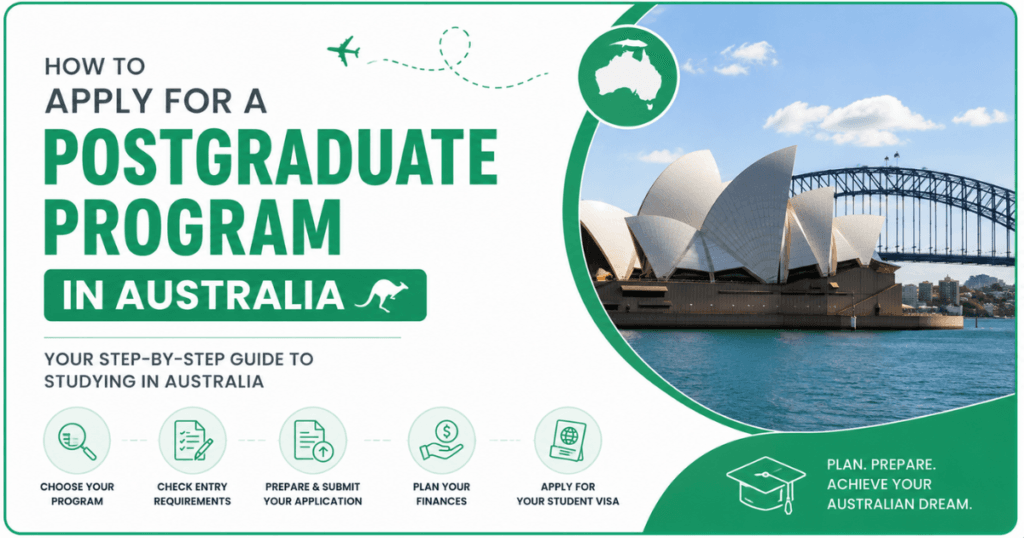
Australia is a popular study-abroad destination for international students, especially those seeking to pursue a postgraduate program. To study a postgraduate degree in Australia as an international student, you will need to have completed your bachelor’s degree, submit an English language proficiency test result, and other supporting documents. Upon receiving your admission from the university, you will need to apply for the Australian student visa (subclass 500).
Australia is a popular destination for its world-class universities, high rates of graduate employability, a diverse and multicultural environment, and strong research opportunities. Every year, thousands of international students flock to Australia to pursue master’s programs.
Before you can travel to Australia to study for a postgraduate program, you must follow the due application process. While this process may seem straightforward, students will need to submit appropriate financial and academic documentation and meet all immigration requirements before they are issued an Australian student visa. In this guide, we will explain everything you need to know as an international student wanting to study in Australia.
Types of Postgraduate Programs in Australia
Australia boasts of some of the globally renowned universities that offer a wide range of postgraduate studies. These include,
Graduate Certificate
This program runs for a short period, from six months to one year. At the end of the study, graduates receive certificates suitable for professionals seeking specialised skills in their careers.
Graduate Diploma
This program runs for one year and provides advanced study beyond what the graduate certificate offers. With this diploma, students can create a pathway to study a master’s degree.
Masters Degree
The master’s degree is one of the most popular postgraduate programs among international students. The master’s program may last between one and three years, and at the end, students are issued a master’s degree certificate. Types of master’s degree programs include Master of Business Administration (MBA), Master of Education, Master of Public Health, Master of Computer Science, and so on.
Doctoral Degree (PhD)
This is a research-focused program that lasts between three and four years. PhD students contribute to the research within their chosen academic field.
Suggested: Australia Student Visa Guide 2026: Requirements, Cost & Process
Admission Requirements for the Australian Postgraduate Program
Before international students can be admitted to study any postgraduate program in Australia, they must meet certain requirements. Some of these include:
Bachelor’s Degree
International students must have completed their bachelor’s degree from a recognised institution. This degree must also be equivalent to an Australian bachelor’s degree.
Academic Transcript
Many Australian universities will request official academic transcripts from the institution where the students have completed their bachelor’s degree. They may also request other degree certificates and academic records as they see fit. All of these are used to assess the student’s eligibility and academic standards.
English Proficiency Test
International students coming to Australia to study in a postgraduate program must demonstrate their English proficiency. This requirement is mainly for students whose country does not speak English as their first language.
Depending on the university, it may favour one English-language proficiency test over another. However, Australian universities accept a wide range of language test results, ranging from IELTS, for which students are expected to score 6.5 or higher for specific programs.
There is also the TOEFL IBT, PTE Academy, and Cambridge English qualifications, which are accepted by most Australian universities. However, it is important that students check with the university to find out which English proficiency test result is required before writing.
Statement of Purpose (SOP)
Some postgraduate programs may require students to submit a statement of purpose SOP. This is where the students explain their academic background, career goals, reasons for choosing Australia, and the program they intend to study. Writing a strong SOP can help strengthen an application, whereas a weak SOP will do the opposite.
Resume or CV
For professional postgraduate programs in Australia, students may be asked to submit their resumes to demonstrate their employment history, skills, and other professional achievements.
Letters of Recommendation
Professional or academic references may be required of some international students before they can enrol in a postgraduate program in Australia. Submitting strong references can influence or support your admission decision.
How to Apply for a Postgraduate Program in Australia
The application process of applying for postgraduate study in Australia follows a straightforward pattern. However, many students make mistakes when they jump from one step to the other. Here is a step-by-step guide to applying.
Research Universities and Programs
Before going to Australia to study, the first step is to research universities and programs you’d like to study in the country. Compare universities, their programs, course content, tuition fees, locations, rankings, and other relevant details. At the end, choose an institution and program that aligns closely with your career goals.
Check Your Eligibility
Once you have narrowed down the universities you would like to attend in Australia, the next step is to review the admission requirements. Carefully research this. Check the academic qualifications, English language requirements, and other professional requirements you may need to meet before you can gain admission.
Prepare Your Documents
Important documents such as your valid passport, your academic transcripts, degrees, certificate, SOP, CV, references, and English language test results. Preparing these documents early will help to avoid delays during your application process.
Begin Your Application
You can submit your application to an Australian university online. Visit the official university website and upload relevant documents, complete the forms, and provide all other details as indicated on the university portals. Also, there is usually a processing fee for submitting your application, which may vary from A$50 to A$100.
Receive an Offer Letter
Once you have applied and submitted your documents, the university will review your application and may offer you admission. If the university chooses to do this, it will issue you an offer letter. The offer letter may be either a conditional or an unconditional offer.
This means that, under the conditional offer, international students are requested to submit additional requirements, which will be specified by the institution. Also, the conditional offer may mean you have to pay part of your tuition fees to secure your place at the university.
An unconditional offer means they are satisfied with all your documents and do not wish to request any additional documents or requirements from the students.
Suggested: What is the Best English Proficiency Test for Studying Abroad?
Accept the Offer
Once the institution has issued you an offer, accept it and meet its terms. This may mean signing the acceptance document and paying the tuition deposit. After you accept the offer and fulfil all requirements, the university will issue you a confirmation of enrolment (COE).
A confirmation of enrolment is an official document issued by the institution upon the student’s acceptance. This COE will then be used during your student visa application. Without this, you cannot apply for an Australian student visa.
How to Apply for an Australian Student Visa
The Australian student visa (Class 500) is an important step that international students must take to study in Australia. After receiving your admission from a registered Australian university and receiving the offer, you’ll be issued the Confirmation of Enrolment, which will be useful during your visa application.
To apply for a visa, submit documents including your passport, passport photographs, academic transcripts, degree certificates, proof of English language proficiency, and financial proof to cover your tuition and living expenses. In general, students are expected to budget AUD $29,710 for their annual living expenses, excluding tuition fees.
Conclusion
Australia is a vibrant study-abroad destination for pursuing a postgraduate program. The country offers flexible study options, world-class universities, and post-study work opportunities for international students.
For many students, applying for an Australian postgraduate degree may seem complex and overwhelming. However, following due process, preparing your documents and starting your application early will give you leverage for your visa application.
Studying for a postgraduate program in Australia is a valuable investment for your future.