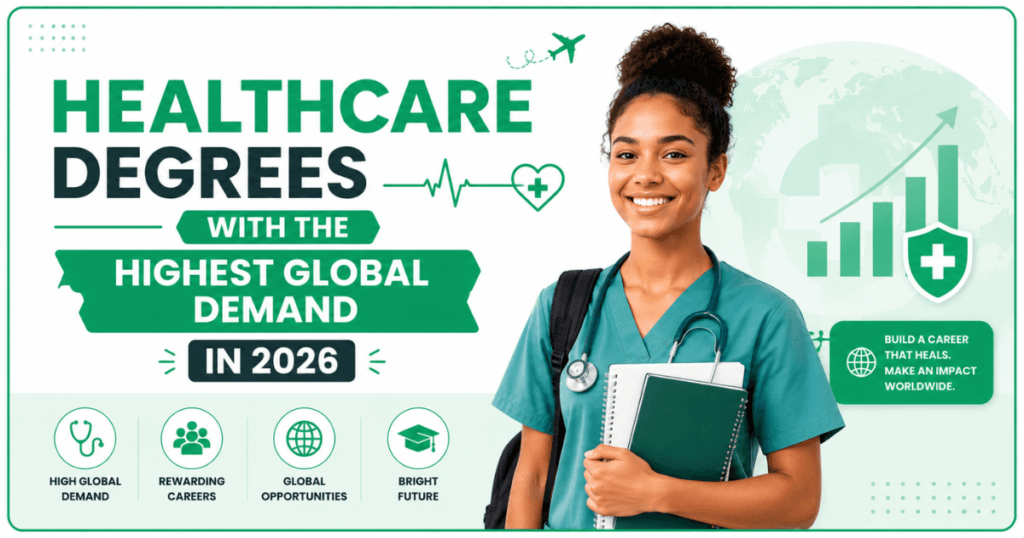
Healthcare courses in high demand worldwide include nursing, physiotherapy, public health, radiography, pharmacy, medicine, and healthcare management. The industry is going to experience many of the most talked-about shortages in modern times, driven by population growth, ageing populations, and rising healthcare needs. There is a growing and urgent demand for qualified healthcare professionals around the world.
In recent years, many students have wanted to study abroad in healthcare programs. This is because they offer more than just academic opportunities. They offer stable work after studies. It is well-paid and a highly respected profession.
In many developed countries of the world, healthcare professionals are already on the skilled occupation list, which means there is a straightforward pathway to getting work visas, permanent residency, and even secure long-term employment for this type of course. As an international student studying a healthcare course in 2026, your career prospects will automatically improve.
In this guide, we will discuss why healthcare professionals are in high demand and highlight some of the highest-demand healthcare jobs across the globe.
Top Healthcare Courses with High Job Demand Abroad in 2026
Medicine (MBBS)
Medicine has consistently ranked among the most in-demand healthcare professional courses worldwide. Healthcare systems all around the world continue to face growing pressure due to shortages of these professionals.
If you study for a degree in medicine, it can open doors to a wide range of career paths in hospitals, research institutes, public health organisations, and even specialist medical practices.
According to the World Health Organisation, there is growing concern about shortages of healthcare doctors in healthcare forces across regions around the world, including Europe, North America, and Oceania.
Medicine Programs
Medicine is one of the highest-paying professions worldwide, although salaries may vary by country, specialisation, and level of experience. As a student, if you want to study medicine, you need to obtain an MBBS or medical degree from a reputable university program.
This program can take between 4 and 6 years, excluding the internship or residency programs. You also need to complete your internship or residency training and other professional licensing examinations in your country of study before you can practice.
Nursing
Nursing as a healthcare profession has always been in demand, even from time immemorial. Many countries around the world are actively recruiting nurses from all over the world due to shortages. If you are studying to become a registered nurse, your career prospects are wide.
You can work in hospitals, clinics, care facilities for the aged, rehabilitation centres, community health care centres, and so much more. As the elderly population continues to grow, there is a persistent global nursing shortage. Countries with strong demand for nursing professionals include Canada, Australia, the United Kingdom, Germany, and Ireland.
As a nursing graduate, you already have a clear path to limited employment and immigration opportunities in developed countries worldwide.
Top Nursing Programs
- Bachelor of Science in Nursing (BSN): As an individual who wants to build a career in nursing, pursuing an undergraduate degree in nursing for 3 to 4 years will provide you with the qualifications. Also, with a bachelor’s degree in nursing, you can qualify to take the licensing exam to become a registered nurse.
- Accelerated BSN/Graduate-Entry Programs: This program is for students who already have a bachelor’s degree in a non-nursing field and want to become nurses. They can take this program for 12 to 18 months to become a nurse.
- Top-Up Degrees & Conversion Courses: For licensed nurses, this top-up program provides an upgrade to practice overseas. It is usually a one-year program for bachelor’s degree holders.
- Master of Science in Nursing (MSN)/ Advanced Practice: The Master of Science in Nursing is for professionals and practitioners who are moving into specialisation or leadership within the nursing field.
Read More: 8 Countries with Easier Student Visas in 2026
Physiotherapy
Physiotherapy is another healthcare professional course that has become in demand globally. Physiotherapists help patients with injuries, chronic conditions, and mobility challenges move around and recover properly. There is a growing need for physiotherapists in sports, ageing centres, rehabilitation centres, and other preventive healthcare areas.
To study as a physiotherapist, you will have career opportunities to work in a number of places, including sports, rehabilitation centres, and as a specialist. Popular study destinations for physiotherapists include, but are not limited to, Ireland, Canada, the United Kingdom, Australia, and New Zealand.
Physiotherapy Modules and Program
An undergraduate program in physiotherapy can take between 3 and 4 years. There is also a postgraduate program that can take 1 to 2 years. Aside from these degrees, there may be professional programs and exams you may need to pass to become fully licensed. However, this is dependent on the country you want to practice.
For instance, to practice in Canada, you must pass the Physiotherapy Competency Examination. In the UK, physiotherapists are managed by the UK Health and Care Professions Council. In Australia, the Physiotherapy Board of Australia manages all professionals in this field.
Public Health
Since the COVID-19 pandemic, the importance of public health professionals has increased significantly. This is because public health professionals can work to improve health management, reduce disease prevention, and participate in research and educational programs for the public.
This set of professionals has increased globally, and they are required in community health initiatives and health policy development. As a public health professional, your career opportunities are endless. You can work as an epidemiologist, public health analyst, health policy advisor, community health coordinator, and so many more. Career opportunities are available in government agencies, NGOs, healthcare institutions, and international organisations worldwide.
Public Health Courses
Undergraduate degrees in public health can take between three and four years. And for a master’s program, this can take between one and two years, depending on the study destination.
For instance, the UK offers a one-year master’s program available for both part-time and full-time study. Students can also take up postgraduate courses in public health, which may take up to 5 years to complete.
Pharmacy
Pharmacists, just like nurses, have remained in high demand for a very long time. It is an essential healthcare profession responsible for administering medications, providing patient education, and delivering other pharmaceutical care. Many healthcare systems rely heavily on pharmacists to support patients with medication and treatment plans.
As a pharmacist, you have wide-ranging career opportunities, including work in hospitals, clinics, research centres, and the community. Many countries around the world are also including pharmacists on their lists of skilled occupations, and demand continues to grow.
Pharmacy Programs and Prospects
Pharmacy courses at most institutions abroad take between four and six years to complete. Master’s courses will take between one and two years to complete. Top pharmacy study destinations in high demand include Australia, the United States, the United Kingdom, and Canada. These destinations also provide pharmacy licensing programs that can allow students to practice in the country.
Radiography and Medical Imaging
This set of professionals plays an important role in diagnostic treatment, especially in medical imaging. Radiographers, on the other hand, are trained to operate sophisticated medical equipment such as CT scanners, MRI systems, ultrasound machines, and X-ray machines.
They remain in high demand in many countries worldwide due to the expansion of healthcare infrastructure and the increased use of diagnostic imaging. In many countries worldwide, experienced healthcare workforce shortages are prevalent in radiography and medical imaging. And recruiting highly qualified professionals in this field is prominent in countries such as the United States, the United Kingdom, Australia, Ireland, and New Zealand.
Radiography and Medical Imaging Programs
As with other healthcare professional courses mentioned earlier, you must complete a three- or four-year undergraduate program in radiography to practice. Also, there are one- to two-year postgraduate courses you can take, and professional exams to write. In the UK, you must register with the HCPC; in Australia, with the Medical Radiation Board.
Read More: STEM vs STEAM in Education: What’s the Difference?
Factors to Consider When Choosing Healthcare Courses To Study
If you are considering studying a healthcare course abroad, here are some points to consider before making a choice.
Accreditation
You should ensure that the healthcare course you want to study is properly recognised and licensed by the regulatory body in the country where you will study.
Employment opportunities
Many healthcare courses and fields are recognised as skilled labour in many countries abroad. Identify and research these opportunities, and ensure they are on the skilled occupation list before you apply to study those courses.
Licensing Requirements
Many healthcare professions require you to register and obtain a license before you can practice in that field. Research and ensure you meet all licensing requirements so you can study and ultimately be employed.
Immigration Pathways
Many countries abroad offer automatic immigration advantages to healthcare professionals and workers due to shortages. Research those courses in your preferred country of study and understand how the immigration processes work.
Practical Training
Several healthcare courses involved practical work. Ensure that the healthcare courses you are taking include clinical placements, internships, and other supervised practices that will help you train and become the best you want to be.
In Conclusion,
The healthcare profession remains one of the most rewarding and secure careers worldwide. Many developed countries are addressing this shortage in the healthcare workforce by recruiting professionals from around the world. If you are an international student seeking to study abroad in 2026, pursuing healthcare programs will provide long-term career stability.
Whether you want to study nursing, physiotherapy, pharmacy, or even healthcare management, these healthcare professions will improve your life while also allowing you to contribute in supporting your community wherever you may be. Choosing a healthcare course to study as an international student will invariably open doors to a successful career for you for many years to come.