
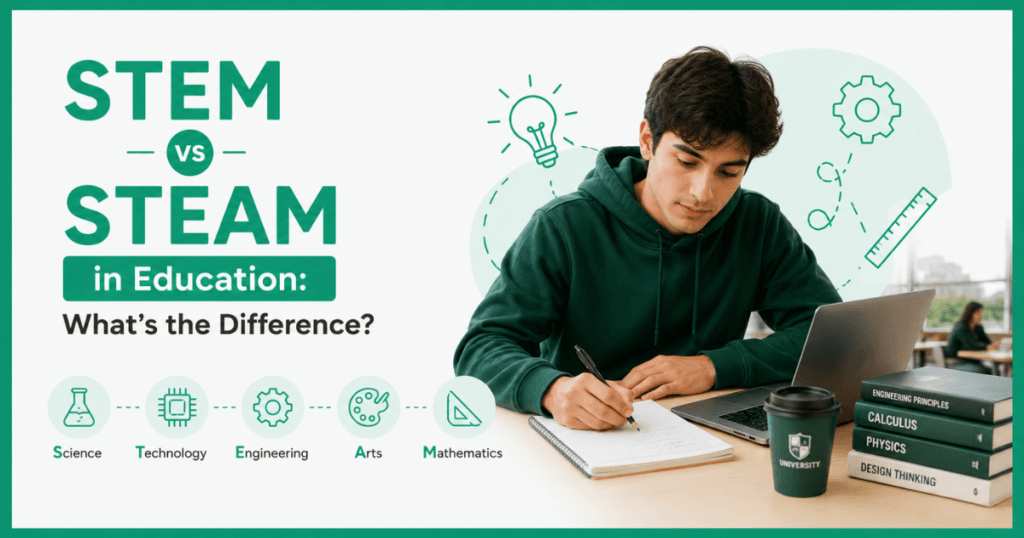
Stem vs Steam: whats the difference? That question has remained constant when it comes to modern education and learning. Educators and researchers worldwide, including parents and teachers, for many years have been concerned with providing education in the subject areas of science, technology, engineering, and mathematics for the future.
Although when you put the words STEM vs STEAM side by side, they sound exactly the same. Nontheless, there is a huge distinction between them and in the impact they will have on the interactions on students.
No matter if you are not sure which is best for you and what the differences actually are in reality, this guide, will explain it all in simple, easy-to-understand terms.
What is STEM Education?
STEM – Science, Technology, Engineering, and Math. This mode of knowledge is rational and problem-solving based on facts. A typical STEM classroom promotes students to consider a problem and solve it logically, based on data.
One project might involve a robot that students have to create to enable it to move on a floor, for instance, and another might be a complicated math problem to deepen their understanding of how gravity works. The first objective of STEM careers is to fill the important positions in today’s economy, including computer programming, medical, chemical, and mechanical engineering. These positions are working to maintain the infrastructure and advance the technology.
What is STEAM Education?
STEAM is the integration of the four core subjects (Science, Technology, Engineering, and Math) with an addition of an ‘A’ for the Arts. This ‘a’ is extremely general. It’s from anything visual, such as painting and photography, but also design, music, drama, dancing, and even creative writing!
STEAM learning is a concept where science and math should not be in isolation. In the real world, a bridge is not only an engineering feat but also a form of architecture, to be adaptable and aesthetically pleasing to a city’s landscape. The arts are integrated, enabling students to combine their imagination with their logic. It’s not simply a matter of creating something that works; it is a matter of making it beautiful, easy to use, and meaningful for its usage.
Read Also: Best Countries for Permanent Residency After Study in 2026
The Main Differences Between STEM vs STEAM
At the classroom level, the greatest disparity is in how students approach a problem. They use some of the same instruments but for slightly different uses.
Problem-solving is key in STEM, and so much emphasis is placed on the “how” and the “what.” During a storm, how does this bridge stay up? What will happen when you blend these two fluids? It is the mechanical basis of the world.
Instead, the “how” and “why” are emphasised by STEAM. Who will be the users of the product? What is important to the person using the colour or shape? Muddies technical topics with a human touch.
These differences are very apparent in early childhood education. Suppose you have a handful of small children and blocks. A STEM-based project would have the teacher have the children construct as tall a tower as they can that will not fall over. Teaches balance and gravity.
In a STEAM project the teacher may invite the children to create a tower that resembles a castle for a particular character and have them share a story of what lives there. This is a physics lesson with creativity and communication.
The “Arts” Matter in Science
Some say bringing art into science cuts away from math or coding, which they consider to be more important. But the improvements are provided by STEAM, which, in turn, demonstrates the value of art enhancing science. Leonardo da Vinci and Albert Einstein, among many great scientists of the past, were all musically talented, painters, or great fans of the arts.
Consider the cell phone you utilise on a day-to-day basis. A group of engineers proved the battery ends up running all day long and the processor is blazing fast (STEM). However, a designer went the extra mile to ensure that you have a phone that looks dazzling, icons that are easy to understand, and a phone that’s comfortable in your hand (Arts).
Today, without inventiveness, most of what we love and use would look ugly, be bulky, and be extremely difficult to operate. Arts give technology its “user experience” that makes it useful to human beings.
Adapting to the Future Workforce of STEM vs STEAM
The world is moving so rapidly that it is transforming at a faster rate. Simple calculations or repetitive tasks are now being replaced by computers and AI in many traditional occupations and jobs. The importance of this information is due to the fact that critical thinking is one of the most important skills that students can have.
In STEM, you are taught how to go through a process to achieve an answer, and in STEAM, you learn how to think “outside the box.” Today’s employers are seeking individuals who can solve problems not possible for a computer through empathy, design, and innovation. Hence, the use of integrated learning across different subjects rather than separating them into different hours is gradually becoming the trend in modern schools within this modern century.
STEM vs STEAM? Which is the Best?
Benefits of STEM vs STEAM Education, and it continues to align strongly with the job markets include:
| STEM Education | STEAM Education |
| Prepares students for careers in AI, cybersecurity, robotics, data science and so on today’s global age. | STEAM education focuses more on students’ creativity and innovation. |
| STEM equips students with critical thinking skill which will become valuable in many career fields. | STEAM promotes communication skills of students and encourages them through creative methods. |
| STEM education empowers students in discovery and innovation through hands-on projects. | With the use of various learning methods, STEAM guides students through engaging methods like art, design and music. |
| Governments all around the world are promoting STEM education as it supports economic growth. | Students learn how to solve problems, focusing on people rather than being technology-centred. |
| STEM is future-focused and teaches students to do so. | STEAM uses empathy and promotes collaboration. |
Why Diversity in Learning Matters
Another key benefit of many educators choosing STEAM is its inclusiveness of science. When kids are artistic by nature, sometimes they feel they’re “no good at math,” as well. These students can sometimes find a love for math and science subjects when integrated into a different approach to art in the classroom.
These subjects combine to blur the distinction between the “brainy” and the “creative” subjects. This would help to attract a wider range of students into careers in STEM fields in subsequent years, providing new approaches to areas of STEM that may be stagnant.
Read Also: What is the Best English Proficiency Test for Studying Abroad?
Simple Ways to Support Learning at Home
Concepts can be helpful for your child without requiring a degree in engineering or a laboratory. Encourage STEM and STEAM in their own homes, in their back yards, and in their own living room:
1: Baking and Cooking: Math and Mixing Flour and Sugar. The rising of the dough in the oven is a chemical reaction (science). Cake decorating with colours and patterns is an art.
2: Building with Recyclables: Set out a pile of cardboard boxes for your child, along with duct tape and markers! Have them create a “city of the future.” This involves the use of engineering for structural safety and using creative design to determine what the city requires.
3: Nature Exploration: Walk and gather various kinds of leaves. Sort them into groups—according to shape or color (math/logic)—and then make a leaf rubbing or collage (art).
4: New Ones: There are applications these days that enable children to manipulate letters or blocks in a digital fashion. This is a perfect method to get some technology in the way of a game.
Update on STEM Policies: Moving Beyond the Acronyms
Although we talk a good game of the letters S, T, E, A & M, the hope is to develop an appreciation for learning, learning for life. Scientists are needed who can determine the path of a rocket, but scientists are also needed who can visualize life on another planet.
With integrated learning, the child’s brain operates on all levels. It brings together the left and right brain sides (logical and creative). Powered by these two faces together, amazing things occur.
Finally,
Learning is now not merely about memorizing a series of dates and formulas to get good grades on a test. It is about knowing how the world works—and how we can make it better. The common denominator of a STEM school versus a STEAM school is the same: to produce a generation of thinkers, creators, and doers.