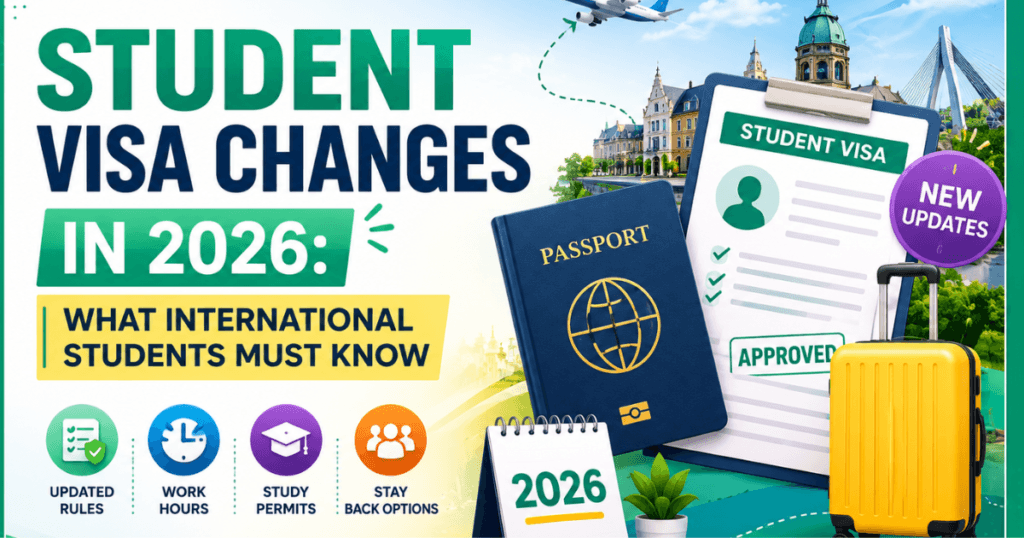
So far, the year 2026 has been a dynamic one for many international students seeking to study abroad. Countries like the United States, Canada, the United Kingdom, Australia, and parts of Europe are introducing tighter visa rules, higher financial requirements, and stricter application screening processes. While obtaining a student visa for most of these countries is still possible for international students willing to study abroad in 2026, the process has become more competitive than ever.
In this piece, we will break down some of the most important student visa changes in 2026 and what they mean for you as an international student willing to study abroad.
Why Are Student Visa Rules Changing in 2026?
The drastic changes in student visa rules across many countries worldwide are due to a number of factors. Some of which include:
- The government is trying to reduce the rate of immigration into the country.
- There is a need for balance between the job market and the number of eligible workers in the country.
- To improve and maintain the level of education.
- Another reason is to address the growing shortages of housing and accommodation.
To get into countries like the UK, Canada, and Australia as an international student, you need to show that you are genuine, provide clear proof of your financial record, and demonstrate your academic goals.
Top Countries With the Most Student Visa Changes in 2026
Countries with the most student visa changes in 2026 include the following:
United States Student Visa Changes 2026
Leading among countries with the most student visa changes in 2026 is the United States. The U.S. has continued to demand increasingly stringent screening processes for international students seeking to study in the country. Some of the key updates of the visa changes include:
- Visa suspension for student visas, F, M and J by the US government effective from January 1, 2026. This affects multiple developing countries. Increased social media screening for applicants for the F1 visa.
- There is higher scrutiny during visa interviews, and it is now compulsory for students to attend a physical interview.
- Changes in policy discussions on the duration of stays for international students after their studies. Students are limited to a four-year stay, which puts an end to the Duration of Status (D/S) and is instead replaced by the Extension of Stay (EOS), where students have to apply after the four-year stay has elapsed.
- Enforcement of visa fees in some categories, like the proposed $250 Visa Integrity Fee.
Aside from the above, international students are now experiencing longer processing times, delayed interviews, and visa refusals. Visa refusals, visa refusals.
To get a faster response time when applying for a US student visa, it is best to apply early, up to 1 year in advance. This will help you to get your documents right and allow for the long waiting period for your visa decision.
Read Also: Australia Student Visa Guide 2026: Requirements, Cost & Process
Australia Student Visa Changes 2026
Australia is another country that has introduced stricter rules and guidelines for student visas (Subclass 500). As an international student seeking to study in the country, these are what you should know:
Change of the Genuine Student (GS)
In the past, international students needed to take the Genuine Temporary Entrant (GTE) test. However, that has been replaced since March 2024 by the Australian Department of Home Affairs’ Genuine Student (GS) requirement.
The GTE allows students to write a 300-word personal statement and to seek permanent residency after their studies. However, with the new GS replacement, international students will respond to short questions.
Also, the GS requirement enables visa officers and the Australian Government to believe that students are coming to genuinely study in the country and not to seek to stay.
Higher English Proficiency Test Scores
International students who want to study in Australia need to score 6.0 or more on the IELTS English proficiency test as a major requirement for the student visa. Postgraduate programs may require a score of 6.5 to 7.0.
Increase in Visa Fee and Living Costs
The visa application fee for the main student visa applicant is AUD 2,000; the cost of living is now AUD 29,710 per year. International students need to show the cost of living in their proof of funds for their student visa. Dependents must have an additional AUD 10,394 for their living costs to be eligible.
Limitations in Work and Study
International students in Australia can work while studying for only 48 hours every two weeks. However, they can work full-time on official holidays such as Christmas or New Year’s. Only master’s and PhD students are allowed to work unlimited hours while studying.
Onshore Switching
The Australian government has placed a permanent ban on individuals who enter the country on a visitor visa and seek to switch to a student visa. As a visitor, if you want to study in Australia, you have to return to your home country to begin the process. This ban was put in place to ensure people enter the country for genuine reasons.
Temporary Graduate Visa (Subclass 485)
The age limit for this visa type was formerly 50, but it has now been reduced to 35. Also, an additional requirement of a 6.0 score in the English proficiency test is compulsory before you can apply.
Canada Student Visa Changes 2026
Canada has also introduced stricter rules for its student visa in 2026, including financial proof, graduate work permits, and so on. Let’s break them down below:
Increased Financial Proof
For international students in Canada, there is an increase in the proof of funds for the cost of living. At least CA$22,895 must be in the student’s account as living expenses for the first year, excluding tuition.
Reduced Study Permits
In 2026, only 408,000 study permits were made available for both new intakes and renewals. This reduction now results in the competition to get a spot. Also, undergraduates must obtain a Provincial Attestation Letter (PAL) or Territorial Attestation Letter (TAL) before they can apply for a study permit.
Master’s and PhD students are exempt from obtaining or submitting a PAL or TAL before they are eligible to apply for a study permit.
Dependents Visa
Undergraduates’ dependents or spouses are not eligible to work in Canada. Only the spouses or dependents of Master’s or PhD students at reputable institutions can obtain the Open Work Permit (OWP), which allows them to work.
United Kingdom Student Visa Changes 2026
The major UK student visa changes of 2026 include:
Financial Requirements
Now, to study in the UK, students must provide a substantial amount to cover their living costs. Students in London need to provide £1,529 per month for their living costs, while those outside London will need to show £1,171 per month for a full academic year.
Dependant Visas
Only PhD students or those studying research programs can bring dependants to the UK on their student visa. The UK Student visa application fee is £558.
Visa Restrictions
There are currently visa restrictions from the UK to countries such as Sudan, Myanmar, Cameroon and Afghanistan to curb the excessive influx of asylum seekers. Those who applied within the UK are still eligible to get their visas.
Post Study Work Visa
The UK has reduced the post-study work stay for undergraduates and master’s students from two years to 18 months. This will take effect from visa applications submitted after January 1, 2027. PhD degree holders’ post-study work visa for PhD degree holders still remains 3 years.
What International Students Must Do in 2026 to Get Approved
Starting the design of the training of many international students, and if you are planning to take this step in 2026, here are some tips to guide you.
- Prepare Early: Many countries in Europe, the US, the UK, Canada, and Australia require more time to process student visa applications. So preparing early, starting up to 6 or 12 months ahead of time, will give you enough time to meet all the requirements and also for the visa systems to make their decision.
- Strengthen Financial Documentation: Financial documentation, such as bank statements, should be well-organised to meet the duration required for the student visa process. These statements should be traceable, consistent, and genuine.
- Write a Strong Statement of Purpose: When it comes to writing SOPs, it is important that you focus on your career and academic goals. Input statements like why you chose your course or the country. Writing a strong SOP will give you more edge when it comes to making a visa decision.
- Conduct Your Research: Many of these countries have implemented stricter visa rules because they have found that many students do not have a genuine intention to come to study. That is why visa officials now take time to scrutinise each application. Therefore, before submitting an application, take the time to research and present yourself to visa officials as genuine, with realistic plans.
Read Also: Working While Studying in Canada: Rules, Jobs & Work Hours
In Conclusion,
In 2026, international students who want to study abroad will need to prepare more than in the past. Now, visa officials want to see your intent, preparedness, and financial means. The truth is, these countries are not outrightly rejecting students or closing their doors, but they are becoming more selective about who they want. To navigate these strict visa changes in 2026, the key is to plan ahead, prepare your documents, ensure they are genuine, and apply strategically.